
— A complete comparison covering compliance, returns, tax efficiency, and exit planning
If you’re exploring fund investment options for the Portugal Golden Visa, you’ve probably noticed a key distinction: it comes in two main types — close ended and open ended funds. They differ significantly in structure, trading, return profiles, and risk characteristics — and these differences directly impact your compliance safety and capital protection as a Golden Visa investor.
In this article, we’ll walk you through a detailed comparison of the differences between open and closed ended funds structure, so you can understand which one better aligns with the Golden Visa investment rules and offers greater security for your situation.
What Is an Open-End Fund?
Open-end funds (OEF) are flexible investment vehicles — you can buy and sell shares at any time. There’s no limit on how many shares the fund can issue, and investors can trade based on the fund’s Net Asset Value (NAV) through banks or authorised agencies.
The key feature is high liquidity: share price = total NAV ÷ number of outstanding shares. The number of shares fluctuates with investor activity, so the fund’s value can rise or fall — much like stocks — bringing both opportunities and risks.
Open-end funds have no fixed term and can theoretically run indefinitely, until the fund manager decides to liquidate.
What Is a Closed-End Fund?
Closed-end funds (CEF) work very differently. They have a defined subscription period — similar to an IPO — during which a fixed number of shares are sold to investors. This period can last up to 2 years or longer.
Once the subscription period closes, no new investors are accepted. The fund then enters its investment phase, deploying capital into specific projects and assets. Finally comes the divestment phase — assets are sold at maturity, and capital gains plus the original investment are distributed back to shareholders.
There is no public secondary market for closed-end fund shares. Most investors hold their shares until maturity. In some cases, fund advisors or general partners (GPs) may buy back shares through mutual agreement.
Some closed-end funds may include contractual put option arrangements under which the GP or fund adviser agrees to repurchase shares at a specified time and price. Availability and terms vary by fund and must be confirmed in the fund’s official documentation.
Fund Terms for Golden Visa Investments
Golden Visa applicants may encounter both open-end and closed-end fund structures. Closed-end funds typically have terms of 7 to 10 years. The form of returns depends on the fund’s structure: some distribute dividends during the holding period, while most aim to realise the largest return at maturity — when assets are sold and capital gains, together with the invested capital, are distributed to shareholders.
It’s important to note that closed-end fund share prices are not determined by trading markets. Instead, the fund’s value is assessed periodically — roughly every six months — through a revaluation of assets and income, similar to a property appraisal.
Open-End Fund vs Closed-End Fund: Key Differences
Buying and Selling
- Open-end funds: High liquidity — buy and sell at any time.
- Closed-end funds: Not publicly traded after issuance. Investors typically hold until maturity. Some funds offer put option arrangements through which the GP or fund adviser will buy back shares at an agreed time and price. The availability and terms of any such arrangement should be verified in the fund’s official documentation and with the relevant CMVM-regulated fund manager.
Number of Shares
- Open-end funds: Unlimited — fluctuates with investor activity.
- Closed-end funds: Fixed — does not change after the subscription period.
Share Pricing
- Open-end funds: Based on daily NAV (total investment value ÷ number of shares).
- Closed-end funds: Based on NAV determined by periodic revaluations, not market supply and demand.
Track Record
- Open-end funds: Usually have an established performance history, though always with the caveat that past performance doesn’t guarantee future results.
- Closed-end funds: Many newer funds lack a track record. However, those in their second or subsequent series may provide data from earlier iterations.
Expected Returns & Predictability
- Open-end funds: Invest primarily in stock and bond markets, with values driven by financial market fluctuations and macroeconomic factors. Their speculative nature makes return prediction challenging.
- Closed-end funds: Typically invest in tangible assets and businesses — renewable energy, agriculture, tourism, technology. Returns are based on the performance of these real assets, enabling more reliable forecasting.
Nature of Returns
- Open-end funds: Interest or dividends from stocks and bonds. However, most open-ended funds do not pay out interest or dividends, as returns are reinvested and capitalized until the exit of the investment.
- Closed-end funds: May include dividends, but most funds realise their biggest returns at maturity when investments are divested and sold.
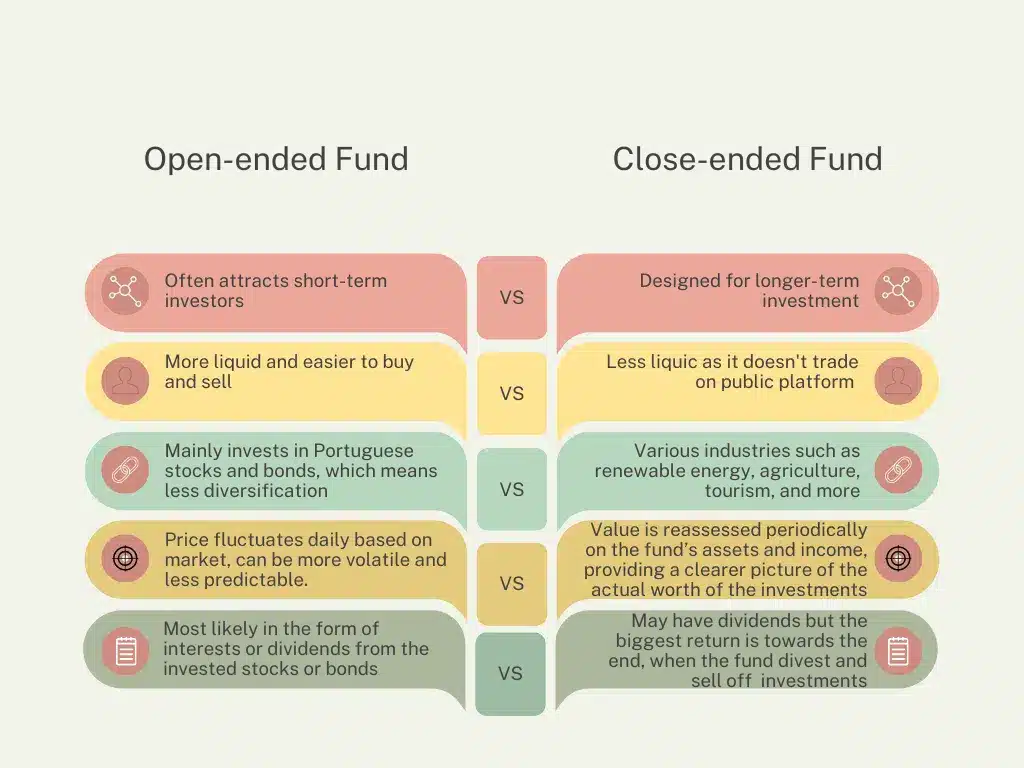
Why Investing In Closed-End Funds Are Better Fit for Golden Visa Investors
After comparing the key differences, you might think open-end funds have the edge in terms of liquidity — and they do. But when your primary goal is immigration, not trading income, the entire investment strategy needs to be reconsidered.
Here are six reasons why closed-end funds may be the smarter choice for Golden Visa investments.
Reason One: The 60% Portuguese Economy Investment Rule
To qualify for the Golden Visa, investment funds must meet a crucial requirement: at least 60% of capital must be invested in the Portuguese economy.
This rule creates a structural challenge for open-end funds.
Consider this scenario: an open-end fund allocates 65% to the Portuguese market and 35% to other markets. If those other markets outperform Portugal (say, US stocks gain 10% while the Portuguese market drops 5%), the fund would need to sell its outperforming US assets and reallocate capital back to Portugal to maintain the 60% threshold. In effect, it’s forced to sell the winners and buy the losers.
Closed-end funds are less affected by this dynamic — their valuations don’t shift dramatically day-to-day, and their asset allocation remains more stable throughout the investment term.

Reason Two: Greater Investment Stability
Open-end funds must chase market trends to maintain optimal returns, often emphasising short-term trading with frequent buying and selling. This exposes investors to sudden changes, potentially forcing the fund to sell assets at unfavourable times.
Closed-end fund investors typically hold until maturity, facing far less pressure from rapid asset sales. This leads to more stable long-term performance — making closed-end funds particularly suitable for Golden Visa applicants with investment horizons of 6–7 years or more. These funds are built for medium- to long-term investment, encouraging investors to hold and focus on long-term growth rather than short-term gains.
Reason Three: More Diversified Investment Options
Open-end funds primarily invest in Portuguese stocks and bonds — but Portugal’s stock market is limited in scale. The PSI (Portugal’s main stock index, formerly the PSI-20) tracks only around 16 companies, and the entire Euronext Lisbon exchange lists approximately 44 companies in total. Only a handful are truly large corporations.
Closed-end funds, by contrast, invest across renewable energy, agriculture, tourism, and technology — creating a more diversified portfolio. Spreading capital across different industries rather than concentrating in a single stock or bond market helps reduce systemic risk.
Reason Four: Higher Return Potential
Open-end fund returns are constrained by the performance of the Portuguese stock and bond markets. The PSI is dominated by traditional energy companies like Galp and EDP, with limited representation of emerging industries.
Closed-end funds invest in specific high-growth sectors such as renewable energy, agriculture, and tourism. Tourism is a major driver of Portugal’s economy, and renewable energy is one of the fastest-growing sectors across Portugal and Europe — providing closed-end funds with greater upside potential.
Reason Five: Predictable Returns & Valuation
Open-end fund prices fluctuate with stock and bond markets, making them more volatile and harder to predict. Closed-end funds are valued based on underlying assets and periodic income assessments, giving investors a clearer picture of their actual investment value. These periodic, predictable revaluations offer greater peace of mind.Some closed-end funds structures also offer a fixed annual return (e.g. 4-6%) with a contractual commitment to repay capital at maturity. This trades lower upside for greater certainty and capital protection — a worthwhile consideration for investors whose primary goal is residency, not speculative growth.
Reason Six: Reduced Market Volatility
Open-end funds are publicly traded and more susceptible to market volatility and investor panic, leading to frequent value swings. Closed-end funds are not traded on public markets, meaning they’re insulated from daily market fluctuations and investor sentiment — resulting in more stable performance.This distinction is especially important during market stress. When large numbers of investors seek to redeem simultaneously, open-end funds may face liquidity shortfalls, impose redemption gates, or be forced to sell underlying assets at a loss. In other words, redemption flexibility does not equal risk protection — it may simply transfer timing risk to the investor.
Compliance Advantage: Smoother AIMA Renewals
Every Golden Visa renewal requires you to submit documentation to AIMA proving your investment remains in place.
Closed-end funds have a clear edge here: unambiguous capital lock-up, stable ownership records, and straightforward documentation. It’s simpler for both you and your lawyer.
Open-end funds require ongoing tracking of subscriptions and redemptions, verification that no structural event has affected your eligibility, and more detailed legal review — significantly increasing the administrative burden.
Tax Tip: A Key Advantage for Non-Tax Residents
Here’s a question many investors ask: Do I need to pay Portuguese tax on my Golden Visa fund returns?
The short answer: if you spend fewer than 183 days per year in Portugal, you are not considered a Portuguese tax resident. In that case, your fund investment profits (capital gains) are generally taxed at 0% in Portugal — provided the fund is not primarily invested in Portuguese real estate.
This means your tax obligations would mainly be handled in your home country, and Portugal’s extensive network of Double Taxation Agreements (DTAs) may further reduce your overall tax burden.
Important note: Portugal’s former Non-Habitual Resident (NHR) special tax regime ended on 31 March 2025 and has been replaced by the IFICI 2.0 programme. Every investor’s tax situation is unique, and we strongly recommend consulting a professional tax advisor before making investment decisions. Learn more about Portugal HNR 2.0
Quick Comparison Table
| Aspect | Open-End Fund | Closed-End Fund |
|---|---|---|
| Share Structure | Unlimited; fluctuates with trading | Fixed after the subscription period |
| Trading | Buy or sell at NAV at any time | Hold to maturity; some offer a put option |
| Fund Term | Indefinite | Fixed, typically 7–10 years |
| Liquidity | High | Low |
| Pricing | Daily NAV | Periodic revaluation |
| Impact of 60% Rule | Higher; may require rebalancing | Lower; allocation is generally more stable |
| Diversification | Concentrated in stocks and bonds | Cross-sector, including renewables, agriculture, and tourism |
| Return Predictability | Lower; market-driven | Higher; based on underlying asset performance |
| AIMA Renewal Complexity | Higher | Lower |
| Tax for Non-Residents | Depends on the fund structure | Capital gains are generally taxed at 0% in Portugal, subject to the fund structure and the investor’s circumstances |
Conclusion
When you weigh up the full picture, closed-end funds offer clear advantages in stability, risk diversification, return potential, valuation predictability, and compliance simplicity — making them a better structural fit for Golden Visa investors.
The average holding period for Golden Visa investments is 6 to 8 years. For this kind of medium- to long-term immigration investment, closed-end funds provide greater security and certainty.
If you prefer higher risk, open-end funds may still appeal to you for their trading flexibility. But remember — the primary goal of a Golden Visa is residency, not trading. The Portuguese PSI is a very different market from the S&P 500, with different growth prospects and investment opportunities.
Contact The Golden Portugal to discuss your Golden Visa strategy, including eligibility, documentation, process, and timeline. Fund-specific terms and investment suitability should be assessed with the relevant CMVM-regulated fund manager and an independent qualified financial adviser.
FAQs:
Are closed-end funds a good investment for the Portugal Golden Visa?
For most Golden Visa investors, yes. Closed-end funds are purpose-built for medium- to long-term holding, aligning naturally with the Golden Visa’s minimum stay commitment. They invest in tangible assets like renewable energy, tourism, and agriculture, and are valued through periodic revaluations rather than volatile public markets. This delivers greater stability, more predictable returns, and simpler AIMA compliance documentation compared to open-end funds. That said, every investor’s risk profile is different , speak with a qualified fund advisor before committing.
Can I invest in open-end funds for the Portugal Golden Visa, and are the returns taxed?
Yes, open-end funds qualify for the Golden Visa provided they are CMVM-registered and allocate at least 60% of capital to Portuguese commercial companies. However, maintaining this threshold can force managers to sell outperforming international assets and reinvest in Portugal’s comparatively small market. On taxation: if you spend fewer than 183 days per year in Portugal, capital gains from qualifying funds are generally taxed at 0% in Portugal. Dividends may attract a withholding tax of 10–28% depending on fund structure. Always confirm your obligations with a professional tax advisor, as your home country’s rules and any applicable Double Taxation Agreement will also apply.
How do closed-end funds simplify the AIMA renewal process?
Closed-end funds hold a fixed share structure with no secondary market trading, making ownership records clean and straightforward to document at each renewal. Open-end funds require ongoing tracking of subscriptions, redemptions, and portfolio composition , which increases legal review time and administrative risk. Some closed-end funds also offer put option arrangements, giving investors a predetermined exit path that adds further certainty to renewal planning. For investors focused on a smooth path to residency or citizenship, this compliance simplicity is a meaningful practical advantage.
How much fund investment is required for Portugal Golden Visa application ?
The Portugal Golden Visa requires a minimum fund investment of €500,000, held for at least 5 years in one or more CMVM-regulated investment funds. The fund must allocate at least 60% of its capital to Portuguese commercial companies and must not invest directly in real estate. Applicants may split their investment across multiple qualifying funds to achieve diversification, provided the combined total meets the €500,000 threshold.
Disclaimer: This article is for educational purposes only and does not constitute investment advice. The Golden Portugal provides guidance on the Golden Visa immigration process and does not select or recommend investment funds. Specific terms, fee structures, and risk profiles vary significantly between funds. Investors should carefully review all relevant legal documents and risk disclosures and consult the relevant CMVM-regulated fund manager and independent legal, tax, and financial advisers before making any investment decision.