
Have you started to notice that the world no longer operates by the rules you once took for granted?
The Middle East in flames. The Russia-Ukraine war grinding into its fourth year. Trade barriers escalating on every front. And at home, a level of political polarization that has moved well beyond partisan bickering into something that directly affects your financial planning, your asset security, and the kind of future you can offer your children. Whether it’s the erosion of institutional norms, the weaponization of the dollar, or the growing unpredictability of federal policy, the sense of stability that Americans once considered a birthright is quietly slipping away.
More and more clear-eyed people are asking themselves the same question: If I need a Plan B, where should it be?
The instinct is to look for somewhere powerful. But power and safety have never been the same thing. A fortress at the center of the storm, no matter how thick its walls, is still part of the storm. The real logic of risk mitigation runs the other way: don’t look for the strongest shield — position yourself where the arrows can’t reach.
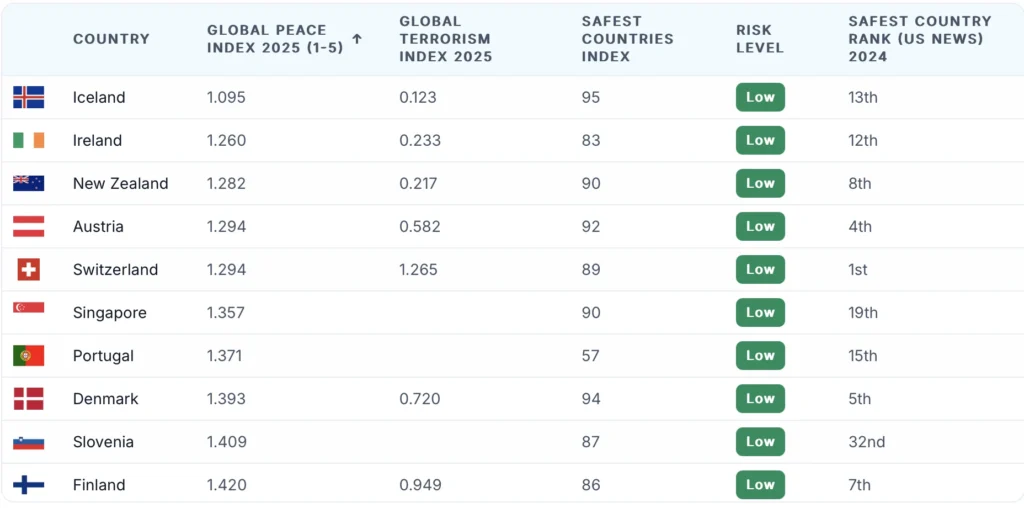
Europe’s Westernmost Geopolitical Moat
Look to the far edge of the European continent.
Portugal, long dismissed as a quiet bystander on the EU’s periphery, holds what may be the most undervalued geopolitical moat in the world today. It is a full member of the European Union and the Schengen Area, with all the legal and institutional protections that come with regional integration. Yet it has managed to stay clear of every major fault line in great-power competition.
This is not an accident. Portugal has maintained the oldest and most stable national borders in all of Europe, having been rarely drawn into external conflicts for centuries. Compare its neighbors: Greece sits next to the Middle Eastern powder keg; Spain is mired in the Catalan separatist question; Malta is too small to offer any strategic depth. Portugal’s position keeps it distant from all of these risk sources while remaining firmly inside Europe’s core institutional framework.
This “insider at the edge” status is its greatest asset.
History Has Already Proven It
Portugal’s safe-haven quality is not theoretical. It has been stress-tested under the most extreme conditions.
During World War II, as totalitarianism and warfare consumed the European continent, Portugal’s pragmatic neutrality policy kept it untouched. Lisbon and its coastline became the last gateway from Europe to the free world.
In the hotel corridors of Estoril, Allied and Axis spies played their shadow games — it was precisely this milieu that inspired Ian Fleming to create James Bond. The Duke and Duchess of Windsor (the former King Edward VIII), members of the Spanish royal family, and countless European elites needing to move their assets all used Lisbon as their final refuge before crossing to the Americas.
The lesson of history could not be clearer: in extreme black swan scenarios, neutrality at the periphery proves more resilient than strength at the center. The places dismissed as “not important enough” during peacetime become the most indispensable marks in times of crisis.
The Atlantic Hub: Protected Neutrality
Portugal’s security is not built on isolation. Quite the opposite — it occupies an extraordinarily strategic hub position in the global geopolitical network.
It maintains the oldest continuous diplomatic alliance in the world, with the United Kingdom, a relationship unbroken for seven centuries. In the mid-Atlantic, the Portuguese Azores Islands serve as a strategic waypoint between Europe and the Americas. The U.S. military base on the islands provides Portugal with an implicit yet effective layer of security.
For Americans, this point deserves special attention: your own military already considers Portugal important enough to maintain a permanent presence there. This balance is a masterwork of geopolitical positioning — under the Western security umbrella without bearing the cost of being on the front line; maintaining independent diplomatic flexibility without being perceived as a threat by any party. For individuals and families seeking a Plan B, this “protected neutrality” is the ideal foundation.
More Than Safety: An Economy on the Rise
If you think Portugal is just a quiet corner of Europe, you are seriously underestimating it.
In 2025, The Economist named Portugal the best-performing economy among all OECD nations — robust GDP growth, low inflation, and strong stock market performance set it apart from its developed-world peers. The European Commission has simultaneously raised its growth forecasts. S&P, Moody’s, and Fitch have all upgraded Portugal’s sovereign credit rating in recent years.
Behind these numbers is real capital voting with its feet. On the Greenfield FDI Performance Index 2025, Portugal ranks near the top, proving it is not merely a country with good press but a destination where the world’s leading capital is actively deploying. Google, Microsoft, and Amazon have all established core European hubs in Portugal. French financial giant Natixis set up operations in Lisbon. German precision instruments firm Testo and French shipbuilder Catana Group have built factories here. Euronext has made Porto its third-largest center. Meanwhile, Portugal’s own ecosystem has produced international tech unicorns like OutSystems.
According to the Henley Private Wealth Migration Report, Portugal now ranks among the top ten global destinations for high-net-worth individual relocation. These people are betting their assets and their lives on a country’s future, and what they see goes far beyond pleasant weather and beautiful coastlines.
Furthermore, most people think diversification means holding a mix of stocks, bonds, and real estate. But genuine risk mitigation runs deeper than asset classes. It means diversifying your currency exposure, so your wealth isn’t denominated in a single monetary policy’s fate. It means diversifying the jurisdiction where your assets sit, your business operates, and your family has legal standing. If your portfolio spans five sectors but every asset sits in the same country, is denominated in the same currency, and falls under the same government’s rules, that is not diversification. It is concentrated risk that merely looks balanced. Portugal offers a rare convergence: euro-denominated assets within the EU legal framework, in a stable jurisdiction outside the crosshairs of great-power rivalry. That is not just a Plan B. It is a structural hedge.
Beyond You: Infrastructure for the Next Generation
For many American families, the calculus of a second residency has moved well beyond personal safety. The question driving the decision is deeper: What structural advantages can I lock in for my children and their children?
This is the most overlooked — and arguably most consequential — dimension of Portugal’s Golden Visa.
Start with wealth transfer. The U.S. federal estate tax rate stands at 40%, and the doubled exemption introduced by the 2017 Tax Cuts and Jobs Act is set to sunset after 2025, dropping the threshold from roughly $13 million back to around $7 million per individual. For families with significant assets, the window for tax-efficient intergenerational transfer is closing fast. Portugal, by contrast, has no inheritance tax. Assets pass between generations without a structural toll. For anyone engaged in long-term family wealth planning, this is not a footnote — it is a foundational difference. And for non-habitual residents (those spending fewer than 183 days per year in the country), global income is tax-free, meaning you can establish an asset haven under the EU legal framework without uprooting your life.
Then there is healthcare — a cost that most Americans have learned to accept as a fact of life but that remains, by any international standard, extraordinary. Portuguese residency grants access to the national public healthcare system from day one. For families weighing the long-term economics of retirement or semi-retirement abroad, this alone changes the equation.
Education is another lever. Portugal offers high-quality international schools with English-medium instruction and IB curricula at a fraction of what comparable programs cost in New York, London, or Singapore. And for university, EU residency opens access to tuition structures that make the American sticker price of $50,000–80,000 per year look like what it is: an outlier, not a norm.
Finally, there is a consideration that fewer people talk about openly but more people think about privately: jurisdictional diversification. In an era of increasing regulatory unpredictability, having a legal foothold — residency, banking access, property rights — inside the EU framework is not paranoia. It is prudence. The Golden Visa’s family structure reflects this: one investment covers your spouse, children, and parents on both sides. It is not a personal lifeboat. It is an ark built for the whole family.
The Window Won’t Stay Open Forever
This is where the true value of Portugal’s Golden Visa lies.
It is not a tourist pass and it is not a short-term investment play. At its core, it is a strategic corridor — in an era of rapidly escalating global uncertainty — to lock in access to safety, to Europe, and to a high-growth economy for yourself and your family. Holding Portuguese residency means freedom of movement across 29 Schengen countries, the full protection of the EU legal framework, access to Europe’s top-tier educational institutions for your children, and a path to preserving family wealth across generations with minimal structural erosion.
But one thing must be faced squarely: this door is narrowing.
In 2023, Portugal closed the most popular real estate investment pathway within the Golden Visa program. Fund-based investment routes remain open for now, but the policy trajectory has sent a clear signal: tightening is the trend, not the exception.
What makes timing especially critical right now is this: applicants who move decisively are currently reaching biometrics within six months of submission. That is not just a processing efficiency — it carries meaningful legal weight. Under Portuguese immigration practice, those who hold a valid residency permit at the time any new policy takes effect are far more likely to be grandfathered under the existing framework. Every month of delay is not just time lost. It is exposure to a set of rules that may no longer favor you when the moment arrives.
Building a Plan B for yourself and your family has never been a sign of panic. Real panic is discovering, after the storm hits, that the umbrellas are no longer for sale.
In a world where black swans are becoming the norm, finding a foothold that is both safe and on an upward trajectory is not wishful thinking — it is the most clear-eyed decision you can make in this era. Portugal’s Golden Visa is the key you can still get your hands on before the window closes.
📩 Want to learn more about Portugal’s Golden Visa eligibility and investment options?
[Schedule a Free Consultation →]
Our team specializes in Portuguese immigration and investment, offering end-to-end professional services from strategy planning and fund selection to residency applications. Whether you’re planning for asset diversification, your children’s education, or long-term family security, we can tailor the optimal pathway for you.